Andrei Shkel
Editor-in-Chief
Submission-to-ePublication = 4.8 weeks, median
sponsored by
Editor-in-Chief: Chief Name
(Editor-in-Chief: Chief Name)
Submission-to-ePublication = 4.8 weeks, median

IEEE Sensors Letters

IEEE Sensors Letters is an electronic journal dedicated to publishing short manuscripts, quickly, on the latest and most significant developments in the field of sensors.

Special Calls for Submissions to present at IEEE Conferences

Open Submissions

Deadline: February 7, 2026
Deadline: September 15, 2026
Deadline: September 30, 2026

Closed Submissions

Upcoming Submissions

Growth of the Journal

2.4
Impact Factor
0.426
Article Influence Score
0.00441
Eigenfactor

Latest Articles

Experimental Characterization of a Nonlinear Electrostatic-Capacitive MEMS Resonator Featuring 1:2 Internal Resonance

Alessandro Nastro; Marco Zini; Pierpaolo Belardinelli; Francesco Clementi; Paola Russo;\ Luca Bastianelli; Luca Rosafalco; Teng Ma; Attilio Frangi; Marco Ferrari

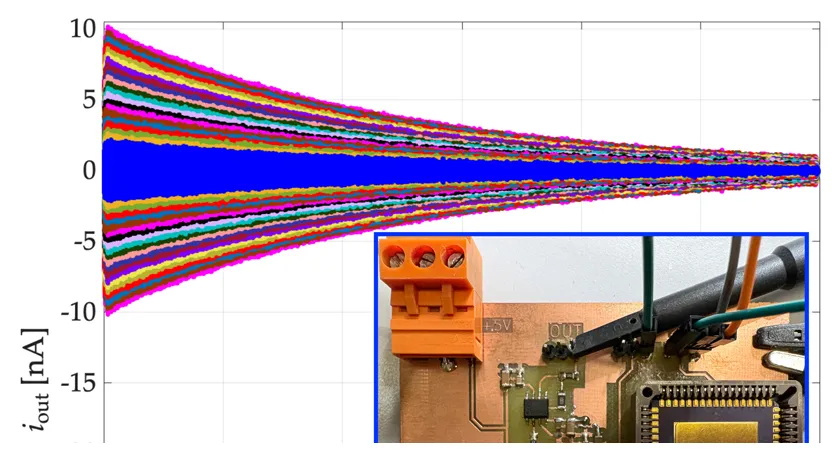
This letter describes the experimental characterization of an electrostatic-capacitive micro electro-mechanical systems (MEMSs) nonlinear resonator exhibiting a 1:2 internal resonance. The proposed MEMS device is based on double-clamped parallel curved beams connected with a vertical link and has been fabricated using the thick epitaxial layer for micro-gyroscopes and accelerometers (ThELMA) process developed by STMicroelectronics. The device geometry combined with the parallel-plate readout mechanism, enhances the nonlinear dynamic behavior, resulting in the coupling of two in-plane vibration modes set by design in a 1:2 frequency ratio. The proposed MEMS resonator has been characterized in the frequency and time domain with and without the electrical activation of the 1:2 internal resonance. A tailored front-end circuit coupled to the resonator has been developed to measure the MEMS transfer function and the free-decay response. Experimental results have demonstrated the possibility to effectively activate the 1:2 internal resonance. The transfer function and the free-decay response highlighted the presence of two distinct harmonic contributions at 416.57 and 837.81 kHz related to the two coupled vibration modes. This behavior is consistent with the presence of nonlinear modal coupling phenomena, in which the energy introduced into the system through the excitation of one mode is partially transferred to the coupled one.

Smart Home-Security System Based on High-Performance Garlic-Peel Biowaste-Derived Triboelectric Nanogenerator

Manas Tiwari; Deepak Bharti

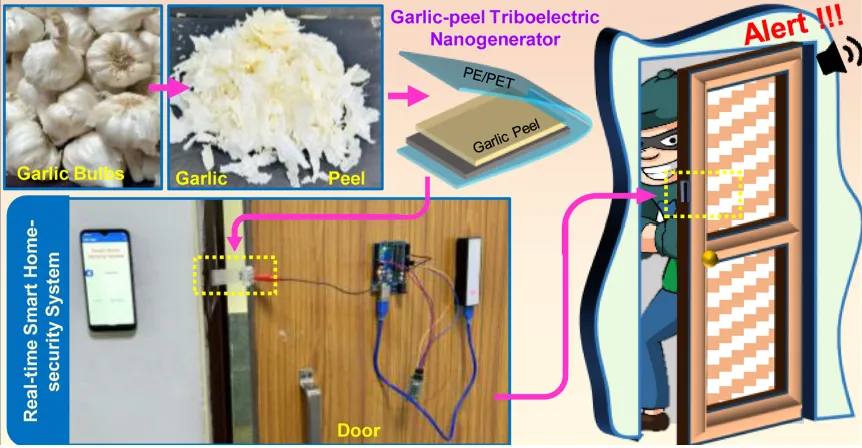
Promising energy technologies, such as triboelectric nanogenerators (TENGs), may be integrated effectively with sustainable materials, such as biowaste, for energy-efficient and self-powered systems for smart electronics and the internet of things (IoT). In this work, garlic-peel (GP) biowaste has been presented as a high-performance active layer of a single-electrode TENG with novel single-sided and dual-sided architectures. Electropositive and lightweight agro-waste of GP generates an open-circuit voltage of ∼210 V and a short-circuit current of ∼45 μA with a power density of 2.16 W/m2 in a single-sided structure when operated in contact-separation mode with waste polyethylene as the counter material. With a shelf-life longer than six months, GP-TENG demonstrates remarkable stability. In addition, electrical outputs of GP-TENG are enhanced to ∼400 V and ∼65 μA with a simple dual-sided geometry. In contrast to other biomaterial-based TENGs being limited to typical energy harvesting, the GP-TENG has been further integrated with a microcontroller-based system to develop a novel, smart home-security application, which generates real-time voice-based alerts on door opening in case of intrusion. This study not only emphasizes the capability of GP as a green and high-performance triboelectric material but also paves the way for the sustainable incorporation of biowaste materials for the development of smart and energy-conscious IoT solutions.

Popular Articles

Sustainable Printed Chitosan-Based Humidity Sensor on Flexible Biocompatible Polymer Substrate

Humidity is one of the most relevant physical parameters to sense and control for a wide range of commercial and industrial applications. Consequently, there is continuing demand for the development of innovative and sustainable humidity sensor solutions. Here, the development and characterization of fully additively manufactured, highly sensitive, resistive Chitosan-based humidity sensors on flexible thermoplastic polyurethane (TPU) foil, as well as on a glass carrier substrate are presented. The sensors unite aspects of sustainability and high performance in a broad humidity range (20–90%rH). The humidity response follows an exponential curve progression with relative changes in the resistance per %rH of 6.9% and 5.7% for the glass carrier sensor and the TPU sensor, respectively. In absolute values, this means that the Chitosan-based sensors are particularly sensitive in the low humidity range with a vast dynamic range (ten times larger compared to commonly used capacitive humidity sensors). The flexible sensor on the TPU substrate shows great stability even after repeated bending. In addition, the combination of flexible and biocompatible materials (TPU and Chitosan) with additive manufacturing technologies makes the sensor particularly sustainable while having great potential for a plethora of biomedical applications.

IoT-Enabled Sensors in Automation Systems and Their Security Challenges

Today, Internet of Things (IoT)-based sensor devices are ubiquitous. Being cost effective and easy to deploy, they are also considered for many applications outside their original domain, which was consumer electronics. Factory and process automation, smart buildings and homes, and, in general, Industry 4.0 are application fields in which the use of IoT technology is gaining popularity, often in addition to existing, classical communication architectures on the operational technology level. IoT devices, however, typically have a different philosophy for communication and data exchange, which makes them easy to use but poses security challenges by bypassing established security architectures, such as the classical defense-in-depth concept defined, for instance, in the IEC 62443 standard. This letter highlights today's security needs and concepts in industrial environments. Furthermore, it looks at possible new attack surfaces opened by IoT-based applications and shows ways how to bridge the security gap.

DeepMUSIC: Multiple Signal Classification via Deep Learning

This letter introduces a deep learning (DL) framework for the classification of multiple signals in direction finding (DF) scenario via sensor arrays. Previous works in DL context mostly consider a single or two target scenario, which is a strong limitation in practice. Hence, in this letter, we propose a DL framework called DeepMUSIC for multiple signal classification. We design multiple deep convolutional neural networks (CNNs), each of which is dedicated to a subregion of the angular spectrum. Each CNN learns the MUltiple SIgnal Classification (MUSIC) spectra of the corresponding angular subregion. Hence, it constructs a nonlinear relationship between the received sensor data and the angular spectrum. We have shown, through simulations, that the proposed DeepMUSIC framework has superior estimation accuracy and exhibits less computational complexity in comparison with both DL- and non-DL-based techniques.


IEEE Sensors Letters
is sponsored by
IEEE Sensors Council

Special Issues

Editorial Board

Andrei Shkel
Editor-in-Chief
University of California, Irvine, USA
Francisco Falcone
Associate Editor-in-Chief
Univ. Publica de Navarra, Spain
Thilo Sauter
Associate Editor-in-Chief
TU Wien and Danube University, Krems, Austria
Giacomo Langfelder
Associate Editor-in-Chief
Politecnico de Milano, Italy
Chia-Chan Chang
Associate Editor
National Chung-Cheng University, Taiwan
Karthik Shankar
Associate Editor
University of Alberta, Edmonton, Canada
Sheng-Shian Li
Associate Editor
National Tsing Hua University, Taiwan
Saakshi Dhanekar
Associate Editor
Indian Institute of Technology, Jodhpur, India
Troy Olsson
Wireless Sensors Topical Editor
University of Pennsylvania, USA
Sarah Ostadabbas
Associate Editor
Northeastern University, USA
Ian Papautsky
Associate Editor
University of Illinois, Chicago, USA
Sri-Rajasekhar Kothapalli
Associate Editor
The Pennsylvania State University, USA
1 2 3 5